The Machine - How UK Pensions Actually Work
You work for decades, paying into a pension, and you are told this is how you will live when you stop working. You will retire at sixty-five, or sixty-six, or sixty-seven, depending on when you were born, and you will receive a pension, money every month, for the rest of your life. The state pension will provide a basic income, and your workplace pension will top it up, and together they will allow you to live comfortably, to enjoy retirement, to stop working after a lifetime of labor.
This is the promise, and for previous generations it mostly worked. People retired at sixty or sixty-five, they received generous pensions, and they lived reasonably well. But for younger people today, the promise is breaking down. The state pension age is rising, workplace pensions are less generous than they used to be, and the amounts being saved are inadequate to fund decades of retirement. The system is under strain, caught between an aging population that needs support and a working-age population that cannot afford to provide it.
Understanding how UK pensions actually work is essential, because the system is not what most people think it is. It is not a savings account where your contributions accumulate and grow. It is a complex web of state provision, workplace schemes, private savings, and intergenerational transfers, all shaped by political decisions, demographic pressures, and financial interests. And the way it operates today is very different from how it operated for previous generations, which means the retirement you are promised may not be the retirement you get.
Let me show you how the UK pension system actually works.
The first thing to understand is that there are different types of pensions, and they work in fundamentally different ways. The state pension, workplace pensions, and private pensions all have different structures, different funding mechanisms, and different levels of security. Most people will rely on a combination of all three, but understanding how each one works is essential for understanding the whole system.
The state pension is the foundation, the basic provision that almost everyone receives when they reach state pension age. It is paid by the government, funded through National Insurance contributions collected from people who are currently working. This is important because it means the state pension is not a savings scheme where your contributions are invested and returned to you later. It is a pay-as-you-go system where today's workers pay for today's pensioners, and when you retire, future workers will pay for you.
The state pension amount depends on how many years of National Insurance contributions you have made during your working life. To get the full state pension, currently around two hundred and three pounds per week, you need thirty-five years of contributions. If you have fewer years, you get less, calculated proportionally. And if you have very few years of contributions, you might get almost nothing, which means people who have worked intermittently, who have taken time out for caring responsibilities, or who have been unemployed for long periods can end up with very little state pension.
And the state pension age is rising, which means people have to wait longer before they can claim it. For people born before 1954, the state pension age was sixty for women and sixty-five for men. But those ages have been equalized and increased, so for people born after 1960, the state pension age is currently sixty-seven. And the government has announced that it will rise to sixty-eight, probably by the late 2030s or early 2040s, and there are already discussions about increasing it further to sixty-nine or seventy.
The political logic behind these increases is demographic, because people are living longer, which means they are claiming pensions for more years, and the working-age population, the people paying the taxes and National Insurance that fund pensions, is not growing fast enough to support that. So the government increases the pension age to reduce the number of years people claim pensions and to keep more people working and paying National Insurance for longer.
But the increases create hardship, particularly for people in physically demanding jobs, people in poor health, or people who cannot find work in their sixties. Being told you must work until sixty-seven or sixty-eight when your body is worn out, when you are exhausted, or when employers will not hire you is not a choice, it is a sentence. And for many people, the rising state pension age means they will not live long enough to enjoy retirement, they will work until they are too sick to continue and then spend their final years struggling.
The state pension is also protected by the triple lock, a policy introduced in 2010 that guarantees the state pension will increase every year by whichever is highest: earnings growth, inflation, or two and a half percent. This sounds generous, and it is, because it ensures the state pension keeps pace with living costs and does not lose value over time. But the triple lock is also expensive, costing billions every year, and it creates an intergenerational transfer where working-age people, many of whom are struggling financially, pay higher taxes to fund pension increases for retirees, some of whom are wealthier than the workers funding them.
The triple lock is politically untouchable because pensioners vote in high numbers and because any government that threatens it faces a backlash, but it also locks in a system where pensioner incomes are protected while working-age incomes stagnate. The triple lock benefits older people at the expense of younger people, and while it provides security for current retirees, it creates resentment and financial pressure on the working-age population that is expected to fund it.
Now let us talk about workplace pensions, which are the second pillar of the system and which have changed dramatically over recent decades. Workplace pensions used to be generous, particularly in the public sector and in large companies, and they were structured as defined benefit schemes, which meant your pension was based on your salary and your years of service. If you worked for thirty years and your final salary was forty thousand pounds, your pension might be two-thirds of that, around twenty-six thousand pounds per year, paid for the rest of your life and usually increasing with inflation.
Defined benefit pensions were gold-plated, secure, and predictable, and they provided genuine financial security in retirement. But they were also expensive for employers, because the employer carried the risk of ensuring there was enough money to pay pensions for decades, and as people started living longer, the costs became unsustainable. So employers, particularly private sector employers, closed defined benefit schemes and replaced them with defined contribution schemes, which are fundamentally different and far less generous.
Defined contribution pensions are savings pots where you and your employer pay in contributions every month, and those contributions are invested in the stock market, and the value of your pension depends on how much was paid in and how well the investments perform. There is no guarantee about what you will get when you retire, because it depends on market performance, on fees, and on how long you live. If the stock market does well and fees are low, you might have a decent pot. If the market crashes or fees are high, you might have very little.
The shift from defined benefit to defined contribution transferred risk from employers to employees, because under defined contribution schemes, you bear the risk of poor investment performance, of high fees, and of outliving your savings. Employers love defined contribution because their obligation ends when they pay the monthly contribution, they do not have to worry about funding pensions for decades, and employees, who often do not understand the difference, accept defined contribution schemes without realizing how much less secure they are.
Auto-enrollment was introduced in 2012 to increase pension saving, because many people, particularly in the private sector, were not saving anything for retirement. Auto-enrollment requires employers to enroll employees into a workplace pension scheme automatically, and both the employer and the employee must contribute. The minimum contribution is currently eight percent of qualifying earnings, with the employer paying at least three percent and the employee paying at least five percent, including tax relief.
Auto-enrollment has increased participation, millions of people are now saving into pensions who were not before, but the contribution rates are too low to provide adequate income in retirement. Eight percent of salary, invested over a working life, will not generate enough to maintain living standards in retirement, particularly if you retire at sixty-seven and live into your eighties or nineties. Financial advisors suggest you need to save at least twelve to fifteen percent of your salary to have a reasonable retirement income, but auto-enrollment sets expectations far below that, which means people are saving, but not enough.
And auto-enrollment contributions only apply to earnings between certain thresholds, not to your entire salary, which further reduces the amount saved. If you earn thirty thousand pounds, only the portion between about six thousand and fifty thousand counts as qualifying earnings, so contributions are calculated on around twenty-four thousand, not the full thirty. This reduces contributions and means low earners, who can least afford reduced pensions, save even less than the headline percentages suggest.
Private pensions, including Self-Invested Personal Pensions or SIPPs, are the third pillar and are used by people who want more control over their retirement savings or who do not have access to a good workplace scheme. Private pensions work similarly to defined contribution workplace pensions, you pay in contributions, they are invested, and the value at retirement depends on contributions and investment performance. But private pensions give you more choice over where your money is invested, which can mean better returns if you choose well, or worse returns if you do not.
Private pensions also come with fees, management fees, platform fees, and fund fees, and those fees compound over decades and can consume a significant portion of your pension pot. A one percent annual fee might sound small, but over forty years it can reduce your final pension pot by twenty or thirty percent, which means tens of thousands of pounds lost to fees. And many people do not understand the impact of fees or do not know what fees they are paying, because pension providers do not make it easy to find out.
Now let us talk about how pensions are paid out. When you retire, if you have a defined contribution pension, you have several options for accessing your money. You can take twenty-five percent of your pot as a tax-free lump sum and use the rest to buy an annuity, which is a guaranteed income for life. You can leave your pot invested and draw down income as you need it, which is flexible but risky because you might run out of money. Or you can take the whole pot as cash, pay tax on seventy-five percent of it, and spend it however you like, though this is rarely advisable because it leaves you with nothing for later years.
Annuities used to be the standard option, and they provide security because they guarantee income for life, but annuity rates are currently very low because of low interest rates, which means you get much less income per pound of pension pot than previous generations did. Someone with a hundred thousand pound pension pot might get an annuity paying four thousand pounds per year, which is very little to live on, and once you buy an annuity, you cannot change your mind, the decision is irreversible.
Drawdown gives you flexibility because you control when and how much you withdraw, but it also gives you risk because if you withdraw too much too soon, or if your investments perform badly, you can run out of money. And most people are not equipped to manage this risk, they do not know how much to withdraw, how to invest, or how to plan for thirty years of retirement, which means they are vulnerable to running out of money or to making poor decisions that leave them worse off.
The system is designed around the idea that people will have multiple sources of income in retirement: state pension, workplace pension, and possibly private savings. But for many people, particularly younger people, this is not how it will work. State pension ages are rising, state pension amounts are modest, workplace pensions are defined contribution with low contributions, and private savings are limited or nonexistent. The combination of all these factors means that many people reaching retirement in the coming decades will have far less income than they need, and far less than previous generations had.
And the system is opaque, most people do not understand how much they are saving, what fees they are paying, what their pension pot is worth, or what income it will provide in retirement. They receive annual statements showing numbers, but those numbers are projections based on assumptions about investment growth and inflation that may not materialize. And people, busy with work and life, do not engage with their pensions, do not check their contributions, do not review their investments, and do not realize until it is too late that they are not saving enough.
So here is what the UK pension system looks like. A state pension paid from current National Insurance contributions, providing a basic income that requires thirty-five years of contributions to receive in full, and a pension age that is rising and will continue to rise. Workplace pensions that have shifted from defined benefit to defined contribution, transferring risk from employers to employees and reducing security and generosity. Auto-enrollment that has increased participation but sets contribution rates too low to provide adequate retirement income. Private pensions that offer flexibility but come with high fees and require financial knowledge most people do not have. And a complex, opaque system that most people do not understand and do not engage with until it is too late to change course.
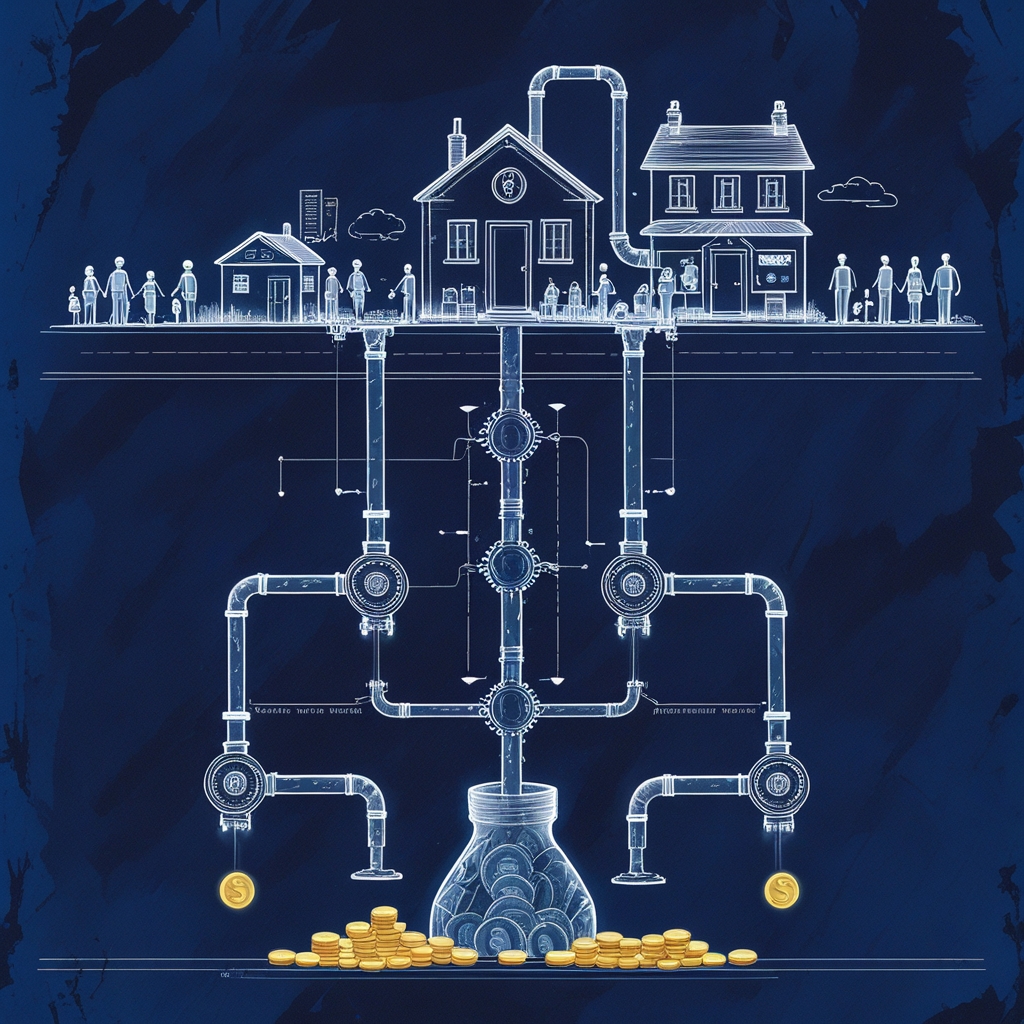
This is the machine, and it is not designed to provide financial security in retirement for most people. It is designed to minimize costs for the state and for employers, to transfer risk onto individuals, and to extract fees from savers at every stage. The promises made about pensions, that if you work hard and save you will have a comfortable retirement, are breaking down, and the generation retiring now is the last generation that will receive generous pensions. Everyone younger is heading toward a retirement that will be longer, later, and poorer than their parents experienced.
The next article will show you who profits from this system, because while pensions are inadequate for most people, they are extremely profitable for some. Pension providers, fund managers, annuity companies, and financial advisors all extract fees and profits from the system, and understanding who benefits is essential to understanding why pensions are structured the way they are and why they do not change.