The Incentives - Who Profits From Money
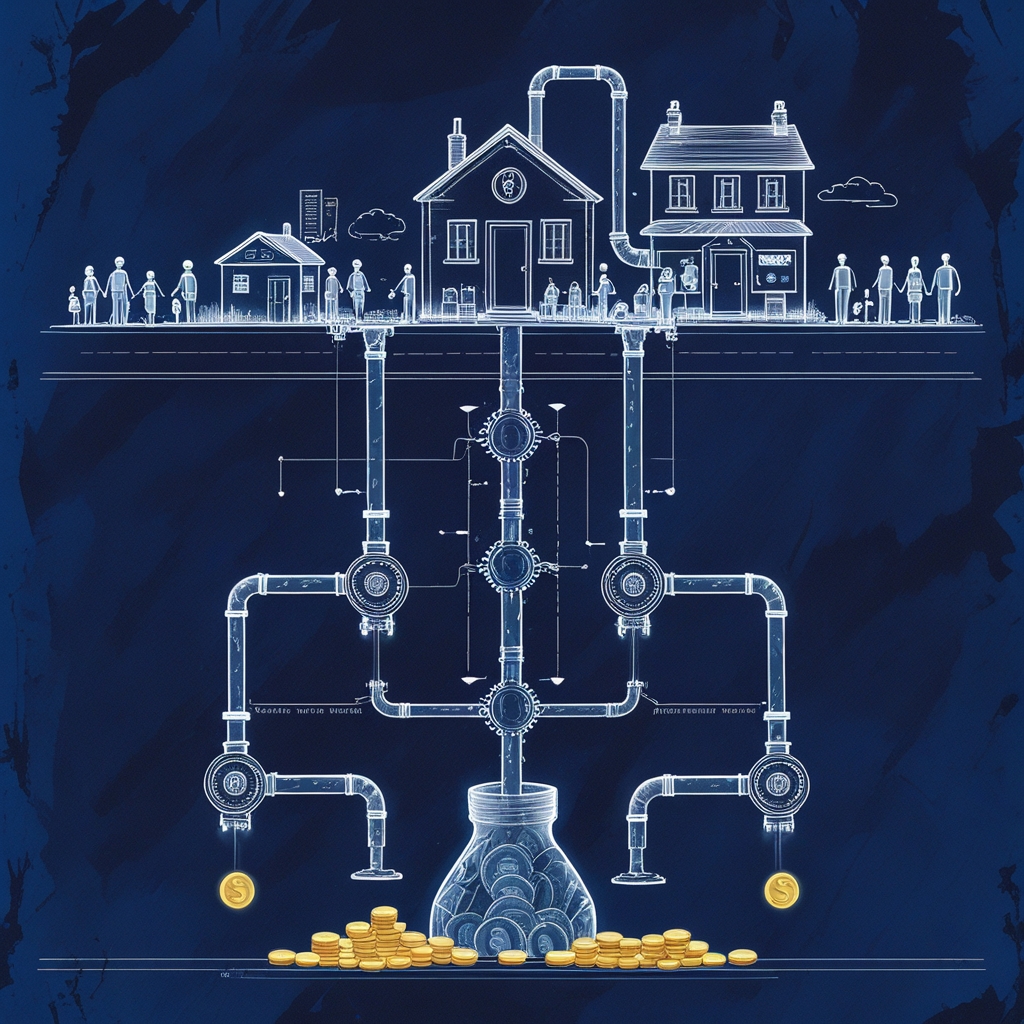
Money moves. And every time it moves, someone profits. Not the person spending it. Not usually the person receiving it. But the people and institutions that facilitate the movement. The ones who create the money. The ones who transfer it. The ones who convert it. The ones who hold it. These are the intermediaries. And intermediation is where the profit is.
The money system is not just a utility. It is not just infrastructure that exists to make transactions easier. It is a business. A very profitable business. And understanding who profits, and how, is the key to understanding why the system is structured the way it is. Because the structure reflects the interests of the people extracting value from it. And those interests are not always aligned with yours.
Let me show you who profits from money.
The first and most obvious beneficiary is commercial banks. Banks profit from lending. When a bank makes a loan, it creates money and charges interest on it. The borrower repays the loan over time, with interest. The loan gets destroyed as it is repaid. But the interest does not. The interest is income. And that income is how banks make money.
Think about a mortgage. You borrow two hundred thousand pounds to buy a house. The bank creates that two hundred thousand pounds by crediting your account. You did not exist before the loan. Now it does. Over the next twenty-five years, you repay the two hundred thousand pounds. Plus interest. Let us say the interest rate is four percent. Over twenty-five years, you will pay roughly one hundred and fifty thousand pounds in interest. The bank created two hundred thousand pounds. And it collected one hundred and fifty thousand pounds in profit. From money that did not exist until the moment you borrowed it.
This is an incredibly profitable model. And it works because the bank is not lending money it has. It is lending money it creates. The risk to the bank is that you do not repay. But if you do repay, which most people do, the bank profits enormously. And the profit comes not from moving money from one place to another. It comes from creating money and charging for its use.
Now, banks do not keep all of this profit. They have costs. Staff. Branches. Technology. Regulation. But the core business model, create money through lending and collect interest, is extraordinarily profitable. And it is protected. Because banking is heavily regulated. And regulation creates barriers to entry. You cannot just start a bank. You need a license. You need capital. You need infrastructure. So the number of banks is limited. And limited competition means higher profits.
The second beneficiary is the central bank. But central banks do not profit in the way commercial banks do. They are not private institutions maximizing shareholder value. They are public or quasi-public institutions with a mandate. Usually, that mandate is to maintain price stability and support economic growth. But central banks do generate income. And that income comes from the same source as commercial bank income. Interest.
Central banks hold assets. Government bonds, mostly. And those bonds pay interest. The central bank collects that interest. It also lends to commercial banks, in certain circumstances, and charges interest on those loans. The income generated is usually returned to the government. But the central bank's power does not come from profit. It comes from control. Control over the supply of money. Control over the cost of borrowing. Control over the stability of the financial system. And that control is influence. Influence over the economy. Influence over governments. Influence over the future.
Central banks are nominally independent. But independence is a spectrum. Some central banks are more independent than others. And even the most independent central banks operate within political realities. Governments appoint central bank governors. Governments set mandates. And governments, when under pressure, expect central banks to act in ways that support political goals. Lower interest rates before an election. Monetary stimulus during a downturn. The central bank has power. But it is not unconstrained power. It is power exercised within a political context.
The third beneficiary is payment processors. Every time you use a card, someone profits. Not you. Not the business you are paying. The payment network. Visa. Mastercard. American Express. These companies do not lend. They do not create money. They move it. And they charge for that movement.
The charge is called an interchange fee. It is a percentage of the transaction. Usually small. One or two percent. But scale matters. Billions of transactions happen every day. And one or two percent of billions is enormous. The payment networks are intermediaries. They sit between you and the business. And they extract value simply by facilitating the transaction. You do not see the fee. The business pays it. But the business passes the cost on to you through higher prices. So you are paying. You just do not realize it.
Payment networks are incredibly profitable. Because once the infrastructure is built, the marginal cost of processing a transaction is almost nothing. A few pence, maybe less. But the fee charged is a percentage of the transaction value. So a payment network earns far more than it costs to process the payment. And because payment networks benefit from network effects, the bigger they are, the more valuable they become. Every business wants to accept the cards that customers use. Every customer wants to use the cards that businesses accept. So the dominant networks stay dominant. And new entrants struggle to compete.
The fourth beneficiary is foreign exchange dealers. Every time money crosses a border, it has to be converted. And conversion is where profit is extracted. The exchange rate you see advertised is not the rate you get. There is a spread. The difference between the rate the dealer buys at and the rate they sell at. And that spread is profit.
For large transactions, the spread is small. A fraction of a percent. But for individuals, for tourists, for small businesses, the spread is much larger. Several percent. Sometimes more. And because most people do not know what the actual exchange rate is, they do not realize how much they are being charged. They just accept the rate they are given. The dealer profits. And the customer, unaware, pays.
Foreign exchange is a vast market. Trillions of dollars change hands every day. And every transaction generates a spread. The dealers, the banks, the brokers, they all take a cut. It is a toll. And because currency conversion is necessary for international trade, for travel, for investment, the toll is unavoidable. You cannot participate in the global economy without paying it.
The fifth beneficiary is governments. Governments do not create most money. But they do create cash. And when they create cash, they profit. This is called seigniorage. The difference between the cost of printing money and the value of the money printed. A ten-pound note costs a few pence to produce. But it is worth ten pounds. The difference is profit. And that profit goes to the government.
Seigniorage used to be significant. When most money was physical, governments earned substantial income from it. But now that most money is digital, seigniorage is a small part of government revenue. The bigger benefit governments get from money is inflation. Inflation is a tax. A hidden tax. When the money supply grows faster than the economy, prices rise. And rising prices erode the value of money. If you hold cash, inflation makes you poorer. But if you owe money, inflation makes your debt cheaper. And governments owe a lot of money.
So inflation benefits the government. It reduces the real value of government debt. It increases tax revenue, because people are pushed into higher tax brackets as their nominal incomes rise, even if their real incomes do not. And it transfers wealth from savers to borrowers. Governments are the biggest borrowers. So they are the biggest beneficiaries. This is why governments, despite claiming to fight inflation, are rarely as aggressive about controlling it as they could be. Because inflation serves their interests.
The sixth beneficiary is the already wealthy. Not because they create money or move money. But because they have access to money. Cheap money. If you have assets, you can borrow against them. At low rates. And you can use that borrowed money to buy more assets. Which appreciate. Which you can then borrow against. The loop reinforces. Wealth generates access to credit. Credit generates more wealth. And the people without assets, the people who cannot borrow cheaply, are left behind.
This is why wealth inequality grows during periods of low interest rates. Low rates make borrowing cheap. But borrowing is only cheap if someone will lend to you. And lenders prefer to lend to people who already have money. Because those people are lower risk. So low interest rates benefit asset owners. They can leverage cheaply. Meanwhile, people without assets see prices rise, housing, stocks, but they cannot access the cheap credit to buy in. They are priced out. And the gap widens.
The seventh beneficiary, ironically, is debt itself. Or rather, the system that depends on debt. Because the money system, as it is currently structured, requires debt to function. Money is created through lending. If lending stops, the money supply contracts. And contraction is painful. Businesses fail. Unemployment rises. Prices fall. Deflation sets in. And deflation, because it makes debt more expensive in real terms, creates a spiral. People and businesses, burdened by debt, cut spending to pay it off. Less spending means less income for others. Less income means more defaults. More defaults mean banks stop lending. The money supply contracts further. The spiral deepens.
So the system has an incentive to keep lending happening. To keep debt growing. Not because debt is good. But because the alternative, contraction, is worse. This is why central banks lower interest rates during downturns. Not to reward borrowing. But to prevent the collapse of the money supply. And this is why governments bail out banks during crises. Not because banks deserve it. But because if banks stop lending, the money system stops working. And if the money system stops working, the economy collapses.
So here is who profits. Commercial banks, through interest on loans. Central banks, through control over the system. Payment networks, through fees on transactions. Foreign exchange dealers, through spreads on currency conversion. Governments, through seigniorage and inflation. The wealthy, through access to cheap credit. And the debt system itself, which requires constant expansion to avoid collapse.
Notice who is not on that list. You. The person using money. You do not profit from the system. You pay for it. Through interest when you borrow. Through fees when you transact. Through spreads when you convert currency. Through inflation when you save. Through higher prices when businesses pass on the costs they incur. You are not a beneficiary. You are a participant. And participation has a cost.
This does not mean the system is a conspiracy. It is not. It is a structure. And the structure has evolved to serve the interests of the people and institutions that have power within it. Commercial banks have power because they create money. Central banks have power because they control the supply. Payment networks have power because they dominate the infrastructure. Governments have power because they set the rules. And the wealthy have power because they have assets.
The system serves those interests. Not because anyone decided it should. But because those are the interests with the leverage to shape the system. And the system, once shaped, reinforces itself. The people who benefit from it protect it. The people who do not benefit from it have little power to change it. And so it continues. Extracting value at every point where money moves. Concentrating wealth in the hands of those who already have it. And ensuring that the system, however flawed, keeps running. Because too many powerful interests depend on it.
The next article will show you the feedback loops that keep this system stable. Why, despite periodic crises, the structure persists. Why reforms are weak and temporary. Why the system resists change even when the change is obviously needed. Because the system is not just a set of institutions. It is a set of incentives. And those incentives create behaviors. And those behaviors create loops. Loops that stabilize the system. Loops that make it very, very hard to disrupt.